materials-chemistry/ai produced the result/Journal of Chemical Theory and Computation 2025 · v2
Researchers train a machine-learned force model to simulate carbon nanotubes' strength and heat limits
A team modelled the stretching and heating of nanotubes rolled from DHQ, a carbon sheet, using classical molecular dynamics. The forces between atoms came from a model trained on quantum-mechanical calculations, because standard empirical force fields did not reproduce the material.
spectrum · one line per step, placed by what the step does · bright lines used AI
Machine Learning Interatomic Potential for Modeling the Mechanical and Thermal Properties of Naphthyl-Based Nanotubes
Journal of Chemical Theory and Computation, 2025
doi:10.1021/acs.jctc.4c01578 · record aix-00193 v2 · checked 2026-10-09
- AI was for
- Simulation surrogate
- Model family
- Linear model
- Checked by
- Held-out
- Code
- not reported
The finding the paper is about came from the AI.
What this research was about
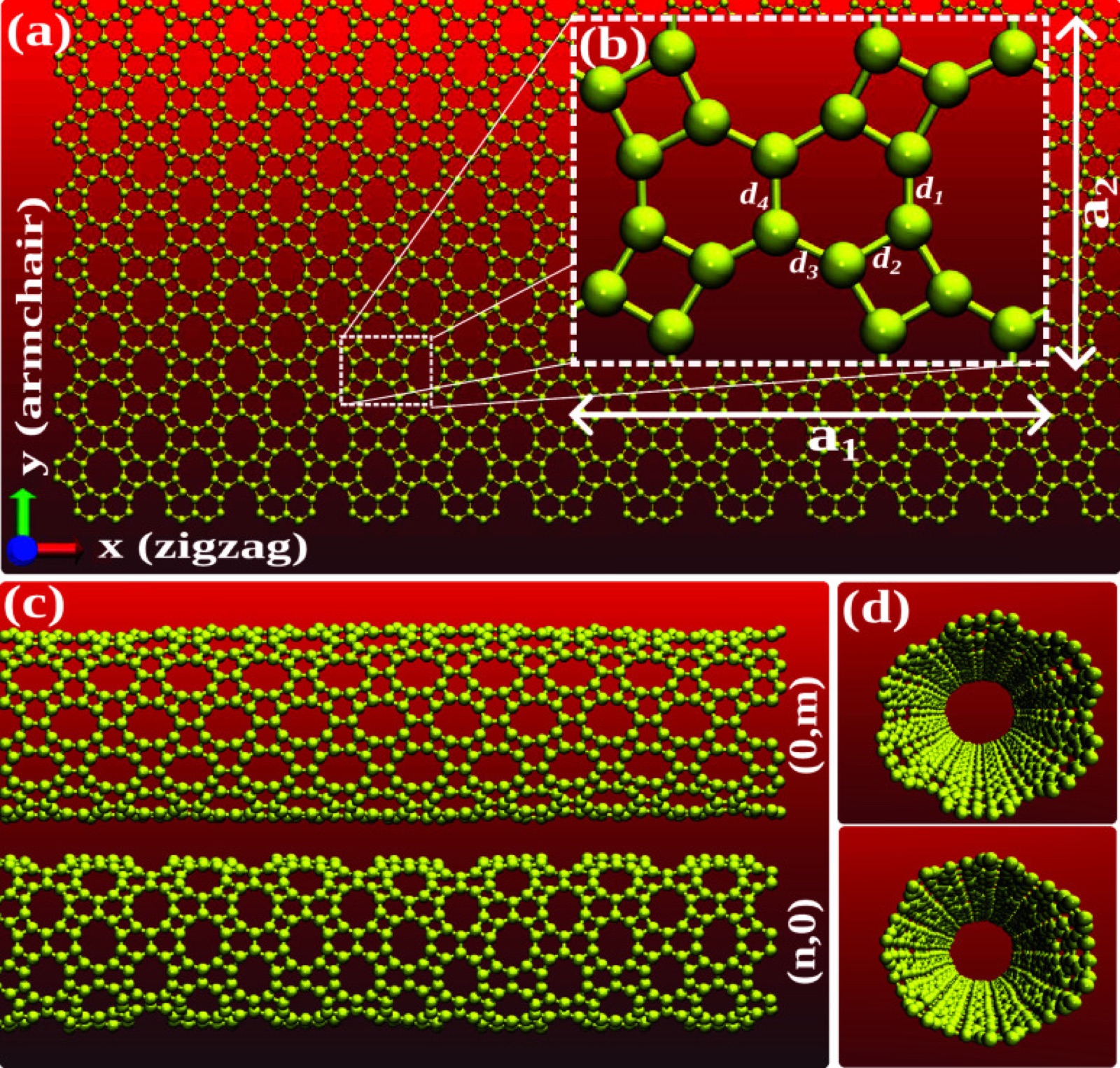
Carbon can be arranged in flat sheets in many ways. The familiar one is graphene, a honeycomb of six-membered rings. DHQ is a different arrangement, built from rings of four, six and ten atoms. Such a sheet can be rolled into a tube, and the way it is rolled, called its chirality, changes how it behaves. To know how strong such a tube is, or how hot it can get before it falls apart, you must track how thousands of atoms push and pull on each other over time. The most accurate way to work out those forces, density functional theory, solves the quantum mechanics directly. It is also far too slow for systems of this size.
The usual shortcut is an empirical force field: a simple formula, fitted by hand, that guesses the forces from the positions of nearby atoms. The researchers report that the ones they tried, (AI)REBO, Tersoff and ReaxFF, did not reproduce the quantum results for this material's structure and mechanical response. So they set out to build a replacement, and then to use it to measure how DHQ monolayers and nanotubes stretch, break and respond to heat.
Where AI came in
The forces themselves came from machine learning. The team ran short quantum simulations of small DHQ cells, squeezed and stretched at a range of temperatures, and recorded the energy, the force on every atom and the internal stresses. A moment tensor potential was then fitted to that record, so that it could predict the same quantities for any arrangement of atoms it was shown. In effect, the trained model stands in for the quantum calculation: it gives the same kind of answer at a cost low enough to simulate systems density functional theory cannot reach.
The fitting was done in two passes. A first version was trained on a tenth of the data, then used to pick out configurations that added something new, and the model was retrained on that larger set. Candidates were judged by their error on held-back data and by whether they reproduced the quantum phonon dispersion, which describes how vibrations travel through the sheet; any model predicting unstable vibrations was discarded. Every mechanical and thermal result reported, the moduli, the breaking strains and the critical temperature, comes from simulations driven by the retained model.
Written by AIxSci from the checked record below, to give context for readers outside the field. It is not part of the record.
The work
Technical · from the record
The authors trained a moment tensor potential on ab initio molecular dynamics data for DHQ, a carbon monolayer built from 4-, 6- and 10-membered rings, and used it to run classical molecular dynamics on monolayers and nanotubes too large for density functional theory. The potential reproduced the DFT phonon dispersion without imaginary modes, with maximum optical modes at 51.6 THz for DFT and 51.9 THz for the trained potential, and reproduced the DFT lattice vectors and bond lengths more closely than ReaxFF did. In the molecular dynamics simulations, Young's modulus of the nanotubes ranged from 127 to 243 N/m depending on chirality and diameter, and fracture occurred at strains between 13.6 and 17.4%. Heating simulations placed the critical temperature at 2200 K, above which the structure lost its periodic ring topology and became amorphous.
How AI was used
A machine-learned interatomic potential was built because the empirical reactive force fields the authors tried, (AI)REBO, Tersoff and ReaxFF, did not reproduce the DFT structure and mechanical response of this material. Training data came from ab initio molecular dynamics in VASP at the PBE/PAW level on 2 x 2 x 1 supercells of 80 atoms, with strains from -15% to 15% in 5% increments applied independently along x and y, giving 13 simulation sets, each of 500 steps at a 1.0 fs time step, at temperatures from 300 to 1000 K. The data set was split 80/20 into training and validation; an initial potential was fitted to 10% of the training configurations using the MLIP package, nonredundant configurations were then selected with that initial potential, and the potential was retrained on the enlarged set by minimising a weighted objective over energies, forces and stress tensors. Chebyshev polynomial degrees and MTP level were varied and the retained setting was levmax 26 with degree-8 polynomials. Candidate potentials were screened by mean squared error against the validation data and by comparing phonon dispersion computed with PHONOPY against the DFT dispersion, with any potential showing imaginary modes discarded. The retained potential was then used in LAMMPS for classical molecular dynamics: equilibration in NPT then NVT at 300 K, uniaxial tensile deformation of monolayer supercells and of armchair and zigzag nanotubes, and stepwise NVT heating runs of 200 ps per temperature.
The shape of the work
Structural · the record, drawn
no AI
Build monolayer and nanotube geometries
Obtaining raw data, whether by measurement, download or retrieval.
To model the DHQ nanotubes, we initially define a chiral vectorwhere the paper describes this · verbatim
no AI
Generate AIMD training data with DFT
Numerical or physics simulation, including where a learned surrogate replaces it.
we built a data set through AIMD simulationswhere the paper describes this · verbatim
no AI
Split data and select nonredundant configurations
Cleaning, filtering, normalising or labelling data already obtained.
it was divided into 20% for validation and 80% for trainingwhere the paper describes this · verbatim
AI
Train the moment tensor potential
Fitting model parameters, including fine-tuning an existing model. The AI stood in for simulation.
An interatomic potential based on machine learning was developed using MTPwhere the paper describes this · verbatim
AI
Validate potential against DFT
Testing outputs against ground truth. Its result feeds back into an earlier step.
This dispersion calculation was also performed for DHQ using the trained force field for comparisonwhere the paper describes this · verbatim
no AI
Compute DFT elastic constants for reference
Numerical or physics simulation, including where a learned surrogate replaces it.
we calculated the elastic constants of DHQ monolayers using DFT, based on the energy-deformation approachwhere the paper describes this · verbatim
AI
Run tensile CMD on monolayer and nanotubes
Numerical or physics simulation, including where a learned surrogate replaces it. The AI stood in for simulation.
CMD simulations were performed to investigate the stress–strain behavior of the DHQ monolayer using the MLIP force fieldwhere the paper describes this · verbatim
AI
Run heating CMD to find phase transition
Numerical or physics simulation, including where a learned surrogate replaces it. The AI stood in for simulation.
CMD simulations were performed at various temperature regimes, ranging from 100 to 2400 K, each lasting for 200 pswhere the paper describes this · verbatim
What the record says
Technical · every part carries its own basis
+ in the paper~ our reading− not reported
How to read the quotations. A quotation shows where the paper describes something. It does not quote every value beside it: one passage locates a part of the work, and values without their own quotation are our reading of that passage.
All reported mechanical and thermal results come from classical molecular dynamics run with the machine-learned potential the authors trained; the paper states empirical force fields were not usable for this material, so the reported properties exist only through the learned model.
An interatomic potential based on machine learning was developed using MTPwhere the paper describes this · verbatim
validation of the field by calculating the mean squared error in the predictions relative to the validation datawhere the paper describes this · verbatim
for providing HPC resources for the SDumont supercomputerwhere the paper describes this · verbatim
What this paper did not report
Technical · absence is published deliberately
- CodeWhether the code is available is not stated.
- Trained model weightsWhether the trained model is available is not stated.
- DataWhether the data are available is not stated.
- How many were testedThe paper gives no count of what was tested.
- Version of Moment Tensor Potential (MTP) for DHQWhich version of the model was used is not stated.
- What step 5 replacedThe paper gives no basis for what the AI stood in for.
About this article
Record aix-00193, version 2, checked by a person on 2026-10-09. The record describes the paper; it does not assess whether the paper's findings are right. The paper is published under CC-BY; quotations are at most 25 words. How we work · Report an error