astronomy/ai produced the result/arXiv 2024 · v2
Diffusion model generates synthetic images of the Sun sorted by flare strength
Researchers trained a generative image model on nine years of solar observations, labelled by flare strength, and then used its invented images of the Sun as extra training material for flare classifiers and predictors.
spectrum · one line per step, placed by what the step does · bright lines used AI
Solar synthetic imaging: Introducing denoising diffusion probabilistic models on SDO/AIA data
arXiv, 2024
doi:10.48550/arxiv.2404.02552 · record aix-00136 v2 · checked 2026-10-09
- AI was for
- Candidate generation, Classification
- Model family
- Diffusion model, Convolutional neural network, Autoencoder, Transformer, Clustering
- Checked by
- Held-out60000 tested
- Code
- not reported
The finding the paper is about came from the AI.
What this research was about
The Sun flares. Bursts of energy erupt from its surface and are graded by the X-ray light they emit, on a lettered scale from the faintest A class up through B and C to the strong M and X classes. Spacecraft watch the Sun continuously, so there is no shortage of pictures. The problem is that the interesting flares are rare. For every violent eruption there are thousands of quiet hours. Software that learns to recognise or anticipate flares from images therefore sees plenty of calm Sun and very little of the behaviour anyone cares about, and it tends to perform poorly on exactly the classes that matter most.
The researchers set out to manufacture the missing examples. They built a set of 20,420 images of the full solar disc taken by the Solar Dynamics Observatory in one ultraviolet channel between 2011 and 2019, matching each image to the flare class recorded at that moment. They then trained a model to produce new images of the Sun to order, for a requested flare class, and tested whether those invented images were close enough to the real thing to be useful.
Where AI came in
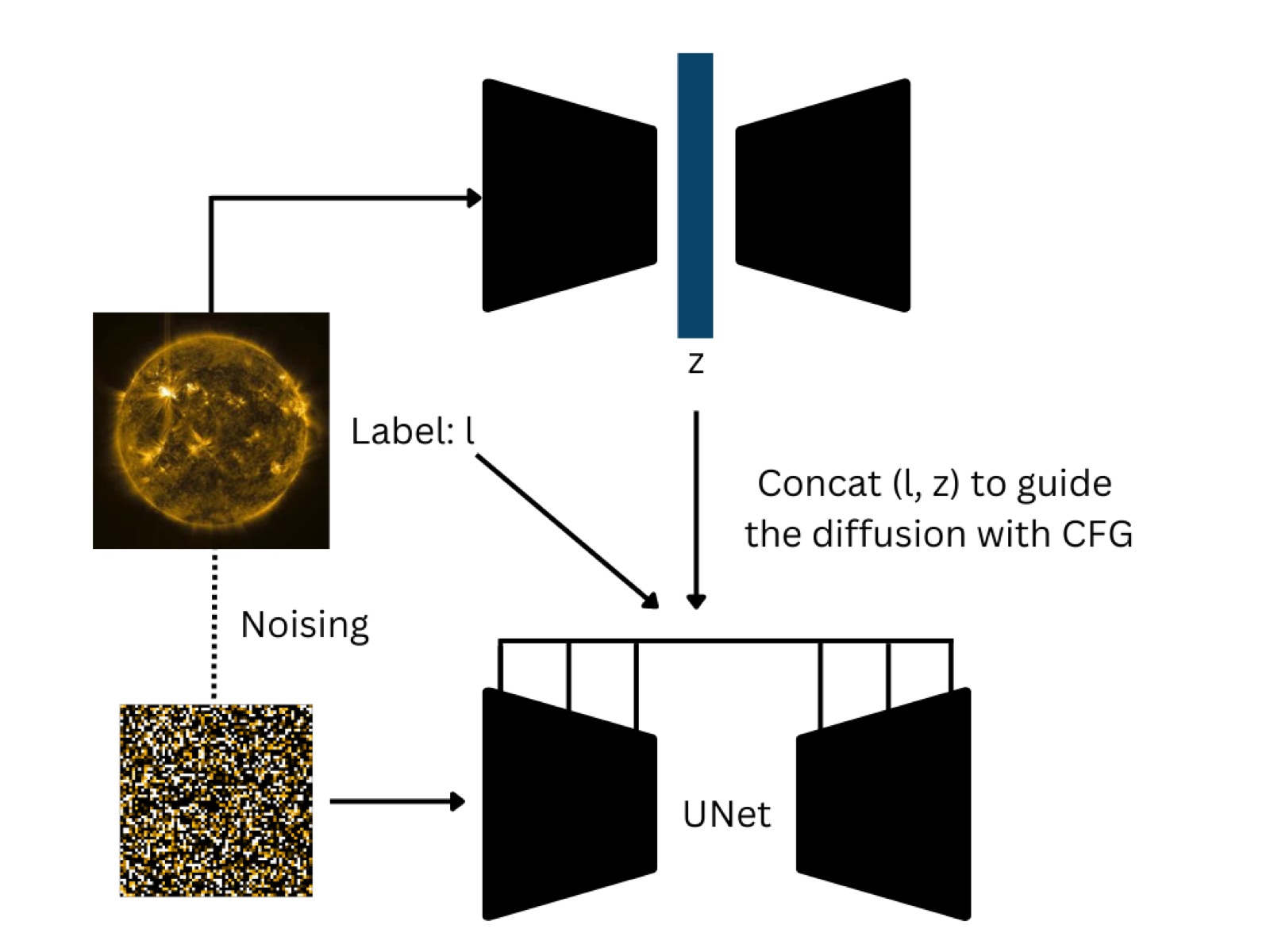
The generator is a denoising diffusion probabilistic model: a system that learns to turn visual static into a picture by removing noise in small steps, and can be steered towards a particular kind of output. Here the steering signal was flare strength. Three versions were compared, one told the flare class as a simple label, one given the measured X-ray value itself, and one given the label alongside features extracted from a second network already trained on solar data. Sixty thousand images were generated and scored, both by statistical comparison with real images and by seeing whether a classifier trained on genuine pictures of the Sun would sort the fakes into the right class.
The synthetic images then became training material. Adding them to the under-represented flare classes raised a classifier's accuracy on those classes, measured against real test images, where standard tricks such as rotating and flipping real pictures did not help consistently. The generated images also went into a system asked to say whether a flare would occur in the next 24 hours. In both cases the model stood in for observations that the Sun itself has not supplied often enough.
Written by AIxSci from the checked record below, to give context for readers outside the field. It is not part of the record.
The work
Technical · from the record
The study trains denoising diffusion probabilistic models to generate synthetic 64x64 full-disc images of the Sun in the SDO/AIA 171 Å channel, conditioned on the GOES flare class of the image; HEK flare peak times were matched to GOES X-ray flux and to AIA frames to build a set of 20,420 labelled images. Three conditioning strategies were compared — discrete GOES classes, continuous GOES X-ray values, and discrete labels combined with ceVAE latent features — and 60,000 generated images were assessed with cluster metrics, FID and a classifier-based F1 score; the discrete-label model reached a macro F1 of 0.38 against 0.54 for the same classifier applied to true data. Adding generated images of the under-represented classes to a supervised classifier's training set raised per-class accuracy, for example 81.9% for the A class with 600 added images compared with 30.1% with none, and 29.1% for the M class compared with 7.1%, while classical image augmentations did not consistently raise accuracy. In a binary 24-hour flare-prediction experiment on 2282 daily images, training with DDPM-generated data gave a TSS of 0.35 ± 0.02 and an HSS of 0.18 ± 0.02.
How AI was used
A denoising diffusion probabilistic model with a U-Net backbone containing self-attention layers between downsampling and upsampling blocks was trained from scratch on AIA 171 Å images at 64x64 resolution, using AdamW, an MSE loss, a learning rate of 3e-4, a batch size of 12 and 500 epochs on one NVIDIA TITAN X GPU, with PyTorch. Images were labelled by cross-matching HEK flare peak times with GOES XRSB flux and then with the nearest subsequent SDOMLv2 frame within a 7-minute tolerance. Three conditioned variants were trained using classifier-free guidance: an embedding layer over the discrete GOES classes, a two-layer encoding of the continuous X-ray value summed with the time-step embedding, and the discrete label concatenated with latent features from a ceVAE previously pretrained on SDO data. Sampling was then run with a specified flare-class label to produce synthetic images in both uniform and dataset-matched class proportions. Evaluation used K-means cluster metrics in the ceVAE latent space, FID computed in CLIP ViT-B/32 and InceptionV3 feature spaces with the clean-fid library, t-SNE for inspecting candidate feature spaces, and a supervised DeIT classifier trained on real images and applied to generated images. The synthetic images were then used as training data in two further experiments: a multi-class DeIT classifier with 200, 400 or 600 generated images added to the A, M and X classes and compared against torchvision geometric augmentations, and a binary 24-hour flare predictor on one image per day with a weighted cross-entropy loss, cosine learning-rate decay, 18 epochs, and 50 to 500 generated images injected per under-represented class.
The shape of the work
Structural · the record, drawn
no AI
Retrieve SDOMLv2, GOES X-ray and HEK event data
Obtaining raw data, whether by measurement, download or retrieval.
In this work, we use three datasets: (1) the version 2 of the SDO Machine Learning Dataset (SDOMLv2)where the paper describes this · verbatim
no AI
Cross-match events and label images by flare class
Cleaning, filtering, normalising or labelling data already obtained.
we finally obtained a new set of 20,420 AIA images that are precisely labelled with their GOES flare classwhere the paper describes this · verbatim
AI
Train three conditional diffusion models
Fitting model parameters, including fine-tuning an existing model.
We train for a total of 500 epochs using the AdamW optimiser, the mean square error (MSE) loss functionwhere the paper describes this · verbatim
AI
Sample synthetic solar images per flare class
Producing candidate objects that did not previously exist. The AI stood in for conventional algorithm.
We produced a total of 60,000 images for these analyses, with each of the three models contributing 20,000 samples.where the paper describes this · verbatim
AI
Score generated images with cluster metrics, FID and classifier F1
Testing outputs against ground truth.
The generative model performance is evaluated using cluster metrics, Fréchet Inception Distance (FID), and the F1-score.where the paper describes this · verbatim
AI
Augment classifier training set with synthetic images
Fitting model parameters, including fine-tuning an existing model. The AI stood in for conventional algorithm.
we trained four identical supervised classifiers, with the only difference between them being the addition of the generated sampleswhere the paper describes this · verbatim
AI
Train binary 24-hour flare predictor with DDPM augmentation
Fitting model parameters, including fine-tuning an existing model. The AI stood in for conventional algorithm.
we conduct a full-disc solar flare prediction as a binary classification problem with a 24 hour time windowwhere the paper describes this · verbatim
What the record says
Technical · every part carries its own basis
+ in the paper~ our reading− not reported
How to read the quotations. A quotation shows where the paper describes something. It does not quote every value beside it: one passage locates a part of the work, and values without their own quotation are our reading of that passage.
The paper's object of study is the generative model itself: the synthetic solar images it produces are the result, and both downstream experiments depend on them
To achieve our goals, we introduce a Denoising Diffusion Probabilistic Model (DDPM)where the paper describes this · verbatim
we train a supervised classifier on true data, test it on generated data looking at the F1 score per classwhere the paper describes this · verbatim
a batch size of 12 and one NVIDIA TITAN X graphics processing unit (GPU)where the paper describes this · verbatim
What this paper did not report
Technical · absence is published deliberately
- CodeWhether the code is available is not stated.
- Trained model weightsWhether the trained model is available is not stated.
- DataWhether the data are available is not stated.
- Version of DDPM conditioned on discrete GOES classes (U-Net backbone, classifier-free guidance)Which version of the model was used is not stated.
- Version of DDPM conditioned on continuous GOES X-ray emission valuesWhich version of the model was used is not stated.
- Version of DDPM conditioned on discrete labels plus ceVAE latent featuresWhich version of the model was used is not stated.
- Version of ceVAE (context-encoder variational autoencoder) pretrained on SDO dataWhich version of the model was used is not stated.
- Version of DeIT (distilled data-efficient image transformer) supervised classifierWhich version of the model was used is not stated.
- Version of DeIT binary solar flare predictorWhich version of the model was used is not stated.
- Version of InceptionV3 encoder (feature space for FID)Which version of the model was used is not stated.
- Version of K-means clustering (scikit-learn) for cluster metricsWhich version of the model was used is not stated.
- What step 3 replacedThe paper gives no basis for what the AI stood in for.
- What step 5 replacedThe paper gives no basis for what the AI stood in for.
About this article
Record aix-00136, version 2, checked by a person on 2026-10-09. The record describes the paper; it does not assess whether the paper's findings are right. The paper is published under CC-BY; quotations are at most 25 words. How we work · Report an error