astronomy/ai produced the result/Astronomy and Astrophysics 2025 · v2
Neural networks sift 315,000 galaxy images for rare polar ring systems
Astronomers trained small neural networks on 87 known polar ring galaxies, topped up with synthetic pictures, then used the models to score a catalogue of 315,000 galaxies. Three of the polar ring galaxies reported were found this way.
spectrum · one line per step, placed by what the step does · bright lines used AI
Discovery of the polar ring galaxies with deep learning
Astronomy and Astrophysics, 2025
doi:10.1051/0004-6361/202555052 · record aix-00055 v2 · checked 2026-10-08
- AI was for
- Classification
- Model family
- Convolutional neural network, Multilayer perceptron
- Checked by
- Held-out3246 tested, 1 worked
- Code
- available
The finding the paper is about came from the AI.
What this research was about
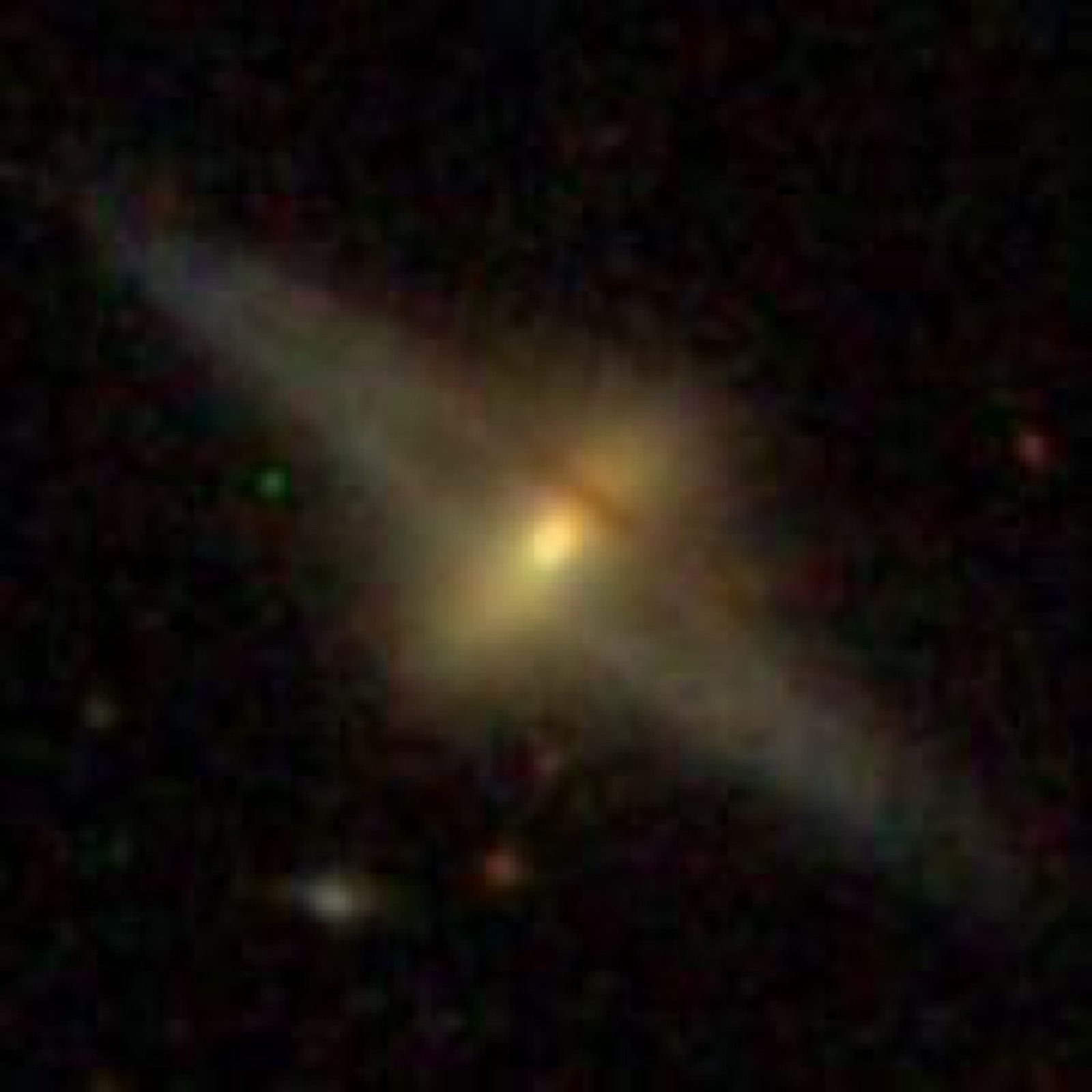
Most galaxies are fairly tidy: a disc of stars and gas turning in a single plane, like a spinning plate. A polar ring galaxy breaks that pattern. It has a second ring of stars and gas looping around the galaxy at a steep angle to the main body, roughly over its poles. Such objects are scarce, and they are awkward to find. A ring seen at the wrong angle can look like an ordinary spiral arm, a dust lane, or two unrelated galaxies happening to overlap on the sky. Telling the real thing apart has traditionally meant looking at pictures one by one, which does not scale to the millions of galaxies in modern sky surveys.
The researchers set out to automate the search. They first gathered the polar ring galaxies already known from existing catalogues and lists, inspected the images by eye, and kept 87 that were classed as strong or good examples with high-quality images from the Sloan Digital Sky Survey. That small, hand-checked set became the training material for a computer search through a much larger catalogue of galaxies relatively close to us.
Where AI came in
The AI here was a set of convolutional neural networks, a kind of model that learns to recognise patterns in pictures from labelled examples. Eighty-seven examples is very little to learn from, so the team stretched the set in several ways: flipping and rotating the images, cutting out just the central galaxy, and combining several models into a voting ensemble. They also generated synthetic pictures of polar ring galaxies and ordinary ones with the galaxy-modelling program GALFIT, trained a network on those, then retrained only its final layer on the real images. This last approach, known as transfer learning, worked best.
The trained models were then run across a catalogue of 315,000 galaxies, giving each one a score for how much it looked like a polar ring galaxy. Scores above a cut left 3,246 galaxies, which people then examined by eye in survey images. The model stood in for the first pass of human eyes, narrowing hundreds of thousands of pictures to a few thousand worth a look. Human judgement still made the final call, and one confirmed galaxy was analysed further with conventional astronomical software. The authors report a test-set accuracy of 95.3 per cent and note it may reflect overfitting.
Written by AIxSci from the checked record below, to give context for readers outside the field. It is not part of the record.
The work
Technical · from the record
The authors assembled a visually inspected sample of polar ring galaxies (PRGs) and used 87 strong and good candidates with high-quality SDSS images to train convolutional neural network classifiers. Because the training sample was small, they used augmentation, central-object segmentation, model ensembling, and transfer learning from a CNN pre-trained on 1,000 synthetic PRG and 3,000 synthetic non-PRG images generated with GALFIT. Applying the final model to a catalog of 315,000 SDSS galaxies produced 3,246 galaxies with scores above 0.999, which were inspected by eye; the paper reports three PRGs discovered via the deep learning approach and four more found by visual inspection of about 2,200 ring galaxies. One discovered galaxy, SDSS J140644.42+471602.0, was fitted with CIGALE, giving a total stellar mass of 8.34 x 10^10 solar masses and a current star formation rate of 71 solar masses per year, which the authors note is limited by missing FUV data.
How AI was used
Galaxy images were prepared by background subtraction, Gaussian smoothing, threshold-based source detection and extraction of the central object, then resized to 80x80 pixels with bicubic interpolation and augmented with random flips and rotations. A CNN with two convolutional blocks, ReLU activations, dropout, pooling, a dense layer and a sigmoid output was trained with binary cross-entropy loss and the AdamW optimizer, with a plateau learning-rate scheduler and hyperparameters chosen by grid search. Two further architectures (one without convolutional layers, one including the segmentation step) were trained and combined into an equally weighted ensemble, and a separate shallow one-hidden-layer network was trained on a 25-fold augmented PRG set. For transfer learning, GALFIT was driven by a modified GalSim code to generate synthetic PRG and non-PRG light profiles, with the polar ring component's Sersic profile truncated by a hyperbolic tangent function and the ring position angle rotated; a CNN was trained on this synthetic set for eight epochs with Adam, most layers were then frozen, and a new output layer was retrained for 35 epochs on 87 real PRG images and 900 non-PRG catalog images. The trained models were run over an SDSS morphological catalog of galaxies at z < 0.1 to assign PRG scores, scores were thresholded to produce candidate shortlists, and the shortlisted galaxies were examined visually using SDSS and DESI Legacy Survey imagery. Photometry of one selected object was measured with the Aperture Photometry Tool and fitted with CIGALE using sfh2exp, bc03, nebular, dustatt_modified_starburst and dl2014 modules.
The shape of the work
Structural · the record, drawn
no AI
Compile and visually inspect PRG sample
Cleaning, filtering, normalising or labelling data already obtained.
Our training sample consisted of 87 PRGs, which were classified as strong and good objects with high-quality SDSS images.where the paper describes this · verbatim
no AI
Augment and segment training images
Cleaning, filtering, normalising or labelling data already obtained.
we defined a custom transformation to segment the central object using the Astropy and Photutils Python packageswhere the paper describes this · verbatim
no AI
Simulate synthetic PRG and non-PRG images
Numerical or physics simulation, including where a learned surrogate replaces it.
In total, 1,000 PRG images and 3,000 non-PRG images were simulated using GALFITwhere the paper describes this · verbatim
AI
Train CNN classifiers on real and synthetic images
Fitting model parameters, including fine-tuning an existing model. The AI stood in for manual curation.
The pre-trained model with a new trainable output layer was trained over 35 epochs using the Adam optimizerwhere the paper describes this · verbatim
AI
Score SDSS galaxy catalog for polar ring pattern
Running a trained model over new data to predict, classify or score. The AI stood in for manual curation.
we decided to apply the final model to the catalog of 315,000 SDSS galaxieswhere the paper describes this · verbatim
no AI
Threshold scores to candidate shortlists
Reducing a candidate set by filtering or ranking, in a single pass.
So, 3,246 galaxies were enough, as expected due to the training data set imbalancewhere the paper describes this · verbatim
no AI
Visually inspect shortlisted candidates
Testing outputs against ground truth.
We have visually inspected these 3,246 galaxies that received a score greater than 0.999.where the paper describes this · verbatim
no AI
Fit multiwavelength SED of one discovered PRG
Extracting understanding from model behaviour.
we exploited CIGALE software for multiwavelength analysis of spectral energy distribution (SED) from UV to IR spectral rangeswhere the paper describes this · verbatim
What the record says
Technical · every part carries its own basis
+ in the paper~ our reading− not reported
How to read the quotations. A quotation shows where the paper describes something. It does not quote every value beside it: one passage locates a part of the work, and values without their own quotation are our reading of that passage.
Three of the reported polar ring galaxy discoveries came from CNN candidate selection over the SDSS catalog; the paper's discovery claim for those objects rests on the model's scores followed by visual inspection
we applied augmentation, image segmentation, and ensemble learning techniques. However, most effective method was transfer learningwhere the paper describes this · verbatim
The model reached an unexpectedly high accuracy of 95.3 % on the test set, which could indicate overfitting.where the paper describes this · verbatim
The programming code of the CNN model with transfer learning, which allowed us to discover this PRGwhere the paper describes this · verbatim
What this paper did not report
Technical · absence is published deliberately
- Trained model weightsWhether the trained model is available is not stated.
- ComputeThe hardware or time used is not stated.
- Version of Main CNN classifier (two convolutional blocks, sigmoid output)Which version of the model was used is not stated.
- Version of Fully-connected model without convolutional layers (ensemble member)Which version of the model was used is not stated.
- Version of Main-architecture CNN with segmentation step (ensemble member)Which version of the model was used is not stated.
- Version of Shallow neural network with one hidden layerWhich version of the model was used is not stated.
- Version of CNN pre-trained on GALFIT synthetic images, output layer retrained on real imagesWhich version of the model was used is not stated.
About this article
Record aix-00055, version 2, checked by a person on 2026-10-08. The record describes the paper; it does not assess whether the paper's findings are right. The paper is published under CC-BY; quotations are at most 25 words. How we work · Report an error