materials-chemistry/ai produced the result/The Journal of Chemical Physics 2024 · v2
Machine-learnt electron densities drive molecular dynamics of a gold–saltwater interface
Researchers trained a machine-learning model to predict how a gold electrode's electrons rearrange in response to nearby salt water, then used those predictions to supply the electric forces in a molecular dynamics simulation of the interface.
spectrum · one line per step, placed by what the step does · bright lines used AI
Accelerating QM/MM simulations of electrochemical interfaces through machine learning of electronic charge densities
The Journal of Chemical Physics, 2024
doi:10.1063/5.0218379 · record aix-00044 v2 · checked 2026-10-08
- AI was for
- Property prediction, Simulation surrogate
- Model family
- Gaussian process
- Checked by
- Held-out400 tested
- Code
- available
The finding the paper is about came from the AI.
What this research was about
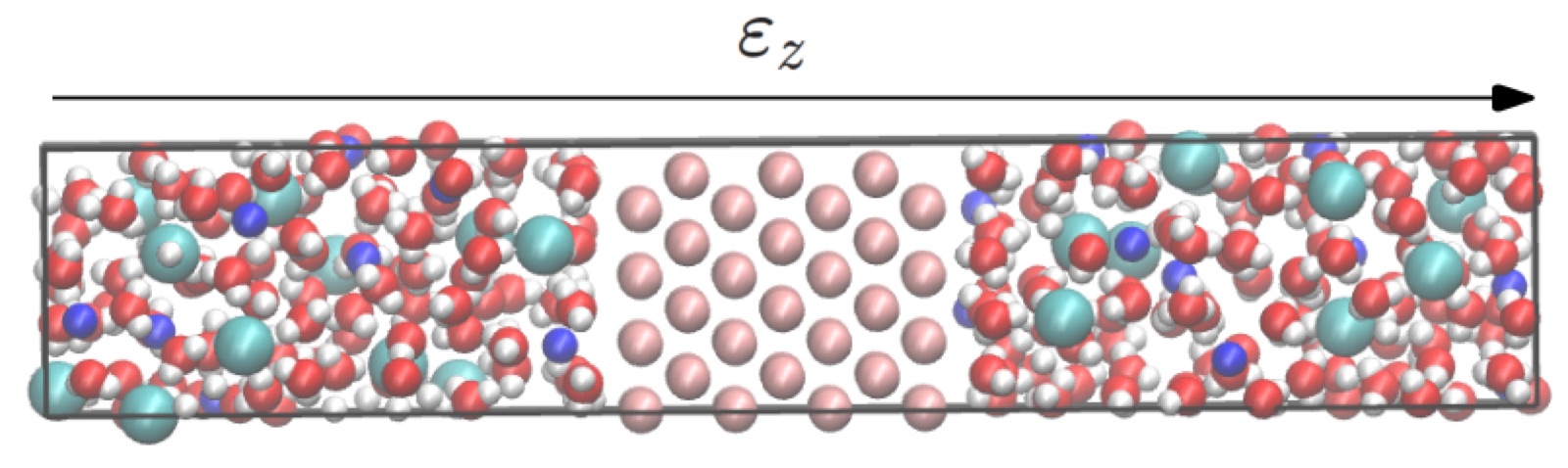
Where a metal electrode meets a salty liquid, a thin layer forms in which water molecules and dissolved ions arrange themselves against the surface. That layer governs how much charge the electrode can hold, which matters for batteries, supercapacitors and electrochemistry generally. The difficulty is that the two sides of the boundary ask for different kinds of physics. The liquid needs long simulations with many thousands of molecules moving over nanoseconds, which only cheap classical models can deliver. The metal needs quantum mechanics, because its electrons are free to slosh about and redistribute in response to whatever sits nearby. Quantum calculations of that electron cloud are far too slow to repeat at every step of a long simulation.
One common compromise is to treat the liquid classically and the electrode quantum-mechanically, an approach known as QM/MM. The quantum part remains the bottleneck. In this work the researchers replaced that quantum step with a model trained to reproduce it, and then compared the resulting simulation of a gold electrode in sodium chloride solution with a purely classical treatment of the same system, at cell potentials of 0 V and 1 V.
Where AI came in
The machine-learning component is a model called SALTED, a form of kernel regression: it learns by comparing a new atomic arrangement with ones it has already seen. Two thousand snapshots of the electrolyte were taken from a classical simulation, and for each one the electrode's electron density was computed with conventional quantum-chemistry software. SALTED was trained on how that density shifted away from the bare electrode's, given the positions of the water and ions. On 400 held-out snapshots the electrostatic forces it predicted differed from the quantum reference by a root mean square error of 1.0 meV/Å, about 0.7% of the spread in the reference forces.
The model then stood in for the quantum calculation during the dynamics itself. At every two-femtosecond step it was asked for the electrode's electron density from the current positions of the liquid, and that density was converted analytically into the electric field acting on the water and ions. Each step took about half a second on a desktop processor, and roughly three nanoseconds were simulated at each voltage. Because the field driving the liquid came from the model, the reported interfacial structure and capacitance rest on it: the water peak sat about 0.5 Å further out than in the classical comparison, a double peak in the sodium profile was absent, and the average electrode charge at 1 V was 0.63 e against 1.16 e classically.
Written by AIxSci from the checked record below, to give context for readers outside the field. It is not part of the record.
The work
Technical · from the record
A symmetry-adapted kernel regression model (SALTED) was trained on Kohn-Sham DFT reference data to predict the electronic charge density of a gold electrode in response to a classical electrolyte, and was coupled to the MetalWalls molecular dynamics code through a spherical-harmonics extension of Ewald summation that turns the predicted density into an electric field. On a held-out split of 400 configurations the predicted electrostatic forces had a root mean square error of 1.0 meV/Å against the DFT reference, about 0.7% of the standard deviation of the reference forces. Running the model-driven dynamics of an Au(100)/NaCl interface for about 3 ns at cell potentials of 0 V and 1 V, each step took about 0.5 s on an Intel i9-12900 CPU. Compared with a classical fluctuating-charge simulation of the same system, the water adsorption peak sat about 0.5 Å further from the surface, a double peak in the sodium profile was absent, and the average electrode charge at 1 V was 0.63 e versus 1.16 e classically.
How AI was used
Two thousand uncorrelated electrolyte frames were taken from a classical finite-field MetalWalls trajectory, and for each one CP2K was used to compute the Kohn-Sham electron density of the gold electrode at the PBE level, expanded into density-fitting coefficients with a truncated Coulomb metric. The regression target was the electrolyte-induced difference from the isolated-electrode density, so that the external field enters only as a small linear perturbation and one model covers a range of cell potentials. Symmetry-adapted kernels were built from long-distance equivariant (LODE) descriptors using the rascaline package, sparsified onto a set of 400 gold atomic environments, and SALTED weights were fitted by minimising a Coulomb-metric loss with regularisation; 1600 configurations were used for fitting and 400 retained for testing. The electric field generated by the predicted density was derived analytically as a spherical-harmonics generalisation of Ewald summation, with short-range terms in real space and long-range terms in reciprocal space, and implemented in MetalWalls. In production, a Python interface called the trained model at every 2 fs timestep to update the electrode density coefficients from the current electrolyte positions, from which the electrostatic forces on the electrolyte atoms were computed; a classical charge-equilibration simulation of the same cell was run for comparison.
The shape of the work
Structural · the record, drawn
no AI
Sample electrolyte configurations by classical MD
Numerical or physics simulation, including where a learned surrogate replaces it.
Reference QM/MM calculations are performed for 2000 uncorrelated frames selected from a classical MetalWalls trajectorywhere the paper describes this · verbatim
no AI
Compute DFT reference charge densities
Numerical or physics simulation, including where a learned surrogate replaces it.
quantum-mechanical calculations are performed at the Kohn-Sham DFT level using the PBE functional with DZVP-MOLOPT-SR basis sets and GTH pseudo-potentialswhere the paper describes this · verbatim
no AI
Build long-range equivariant descriptors and kernels
Encoding data into features, descriptors, embeddings or graphs.
kernel functions between atomic environments are constructed from long-distance equivariant (LODE) structural descriptorswhere the paper describes this · verbatim
AI
Train SALTED electron-density model
Fitting model parameters, including fine-tuning an existing model. The AI stood in for simulation.
SALTED models of the electrode charge density are trained following the discussion of Sec. II-Bwhere the paper describes this · verbatim
AI
Test predicted densities, fields and forces against DFT
Testing outputs against ground truth. The AI stood in for simulation.
we compute the predicted Cartesian components of the electrostatic atomic forces associated with the 400 electrolyte configurations used for testingwhere the paper describes this · verbatim
AI
Run data-driven QM/MM molecular dynamics
Numerical or physics simulation, including where a learned surrogate replaces it. The AI stood in for simulation.
Predictions of the electrostatic atomic forces are obtained from a SALTED model trained on N=2000 configurationswhere the paper describes this · verbatim
no AI
Run classical fluctuating-charge comparison simulation
Numerical or physics simulation, including where a learned surrogate replaces it.
we represent the partial charges on the gold atoms through a Gaussian width of σMW=1.06 Åwhere the paper describes this · verbatim
no AI
Analyse interfacial profiles, surface charge and capacitance
Extracting understanding from model behaviour.
the thermal distribution of water molecules obtained through our method displays a systematic shift with respect to the result of a classical simulationwhere the paper describes this · verbatim
What the record says
Technical · every part carries its own basis
+ in the paper~ our reading− not reported
How to read the quotations. A quotation shows where the paper describes something. It does not quote every value beside it: one passage locates a part of the work, and values without their own quotation are our reading of that passage.
The electrode electron density predicted by SALTED supplies the electric field that drives the reported molecular dynamics, so the interfacial structure and capacitance results are produced by the model
kernel functions between atomic environments are constructed from long-distance equivariant (LODE) structural descriptorswhere the paper describes this · verbatim
we select 1600 random configurations for training and retain the remaining 400 for testingwhere the paper describes this · verbatim
The data that support the findings of this study are openly available from Zenodo.where the paper describes this · verbatim
What this paper did not report
Technical · absence is published deliberately
- Trained model weightsWhether the trained model is available is not stated.
- Version of SALTEDWhich version of the model was used is not stated.
About this article
Record aix-00044, version 2, checked by a person on 2026-10-08. The record describes the paper; it does not assess whether the paper's findings are right. The paper is published under CC-BY; quotations are at most 25 words. How we work · Report an error