materials-chemistry/ai produced the result/Physical review. B./Physical review. B 2025 · v2
Neural network models simulate how lead titanate loses its electrical polarisation on heating
Researchers trained two neural networks on quantum-mechanical calculations of lead titanate, then used them to run atom-by-atom simulations of the crystal's heating. The models supplied the forces and the dipole moments that every reported trajectory and spectrum rests on.
spectrum · one line per step, placed by what the step does · bright lines used AI
Thermal disorder and phonon softening in the ferroelectric phase transition of lead titanate
Physical review. B./Physical review. B, 2025
doi:10.1103/physrevb.111.094113 · record aix-00216 v2 · checked 2026-10-09
- AI was for
- Simulation surrogate, Property prediction
- Model family
- Multilayer perceptron, Linear model
- Checked by
- Held-out600 tested
- Code
- available
The finding the paper is about came from the AI.
What this research was about
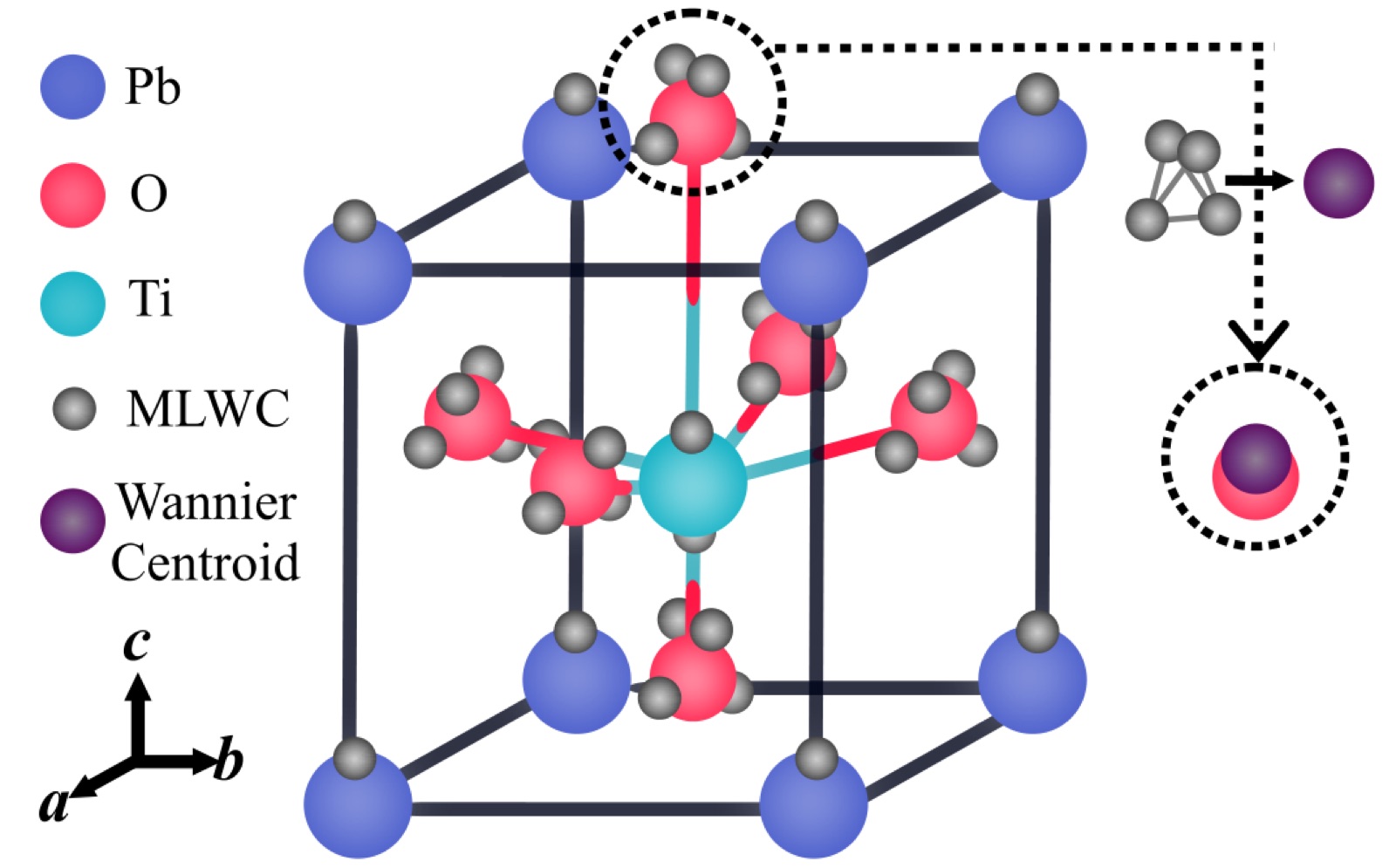
Lead titanate is a ferroelectric: below a certain temperature its crystal carries a built-in electrical polarisation, because the atoms sit slightly off-centre in a consistent direction. Heat the crystal past that temperature and the polarisation vanishes, leaving a paraelectric state. Physicists have long argued about what actually happens at the atomic scale. One picture has the off-centre displacements shrinking towards zero. Another has them keeping their size but losing their shared direction, so the polarisation averages out. Telling the two apart needs a view of individual atoms moving in real time, which experiments cannot easily give. Calculating the forces between atoms directly from quantum mechanics is accurate but far too slow for large crystals over long times.
The researchers set out to follow the transition in lead titanate atom by atom, tracking both the size and the direction of the tiny electrical dipoles in each region of the crystal, and to work out whether the change spreads from a growing patch or appears as scattered fluctuations throughout. They also wanted properties that could be checked against laboratory measurements, including lattice dimensions, heat capacity, polarisation and infrared spectra.
Where AI came in
Static quantum-mechanical calculations on small blocks of lead titanate supplied reference values: energies, the forces on each atom, and the local and total dipole moments. Two neural networks were then trained on these, one for the energy and forces and one for the dipoles, each looking only at an atom's neighbours within six ångströms. Training used an active learning loop, in which the models themselves flagged configurations they were unsure about so that fresh quantum calculations could be run on those. A simpler linear model of the dipoles was fitted to the same data for comparison. Of 5,032 collected data points, 4,432 trained the energy model and 600 were kept back to test it.
The trained networks then stood in for the quantum calculations inside the molecular dynamics, stepping the atoms forward every 0.5 femtoseconds in cells up to fifteen unit cells across, and in a long cell containing a boundary between two differently oriented regions. Because the models were fast, the researchers could also run trajectories at temperatures just past the transition and watch the dipoles rearrange. Spectra came from the dipole model's output over time. The record notes that the paper's conclusions about the transition mechanism depend on these models.
Written by AIxSci from the checked record below, to give context for readers outside the field. It is not part of the record.
The work
Technical · from the record
Two neural-network models were fitted to SCAN density functional theory data for lead titanate: one representing the potential energy surface and one representing the local and total dipole moments. Molecular dynamics driven by these models reproduced the measured tetragonality, lattice constants, enthalpy, specific heat and polarization across the ferroelectric to paraelectric transition, with a transition temperature of 821 K about 60 K above the experimental value. The simulations showed that the average local dipole magnitude falls only slightly across the transition, from 2.1 eÅ to 1.7 eÅ, so the transition is dominated by orientational disordering, and that the system changes phase through nanoscale fluctuations distributed through the sample rather than by nucleation of a growing domain. Simulated far-infrared spectra reproduced the Raman-measured mode frequencies and showed a zero-frequency Debye relaxation feature coexisting with the soft mode near the transition temperature.
How AI was used
Static SCAN density functional theory calculations on 3x3x3 PbTiO3 supercells supplied energies, Hellmann-Feynman forces, virial tensors and, via maximally localized Wannier centroids, local and total dipole labels. A deep potential energy model and a deep dipole polarization model, both with a 6 Å spherical cutoff on the atomic environment, were trained on these labels using an active learning protocol automated with DP-GEN, with LAMMPS as the molecular dynamics engine and DeePMD-kit for training; 4432 of 5032 collected data points trained the energy model and 600 were held out, while the dipole model was trained on a reduced set of 1835 labelled points with a separate 61-point test set. A linear model with static Born charges as trainable parameters was fitted to the same dipole data for comparison. The trained models then drove all-atom NPT molecular dynamics with a 0.5 fs time step, under an added artificial hydrostatic pressure chosen to match the experimental room-temperature tetragonality, to obtain lattice constants, enthalpy, specific heat, spontaneous polarization and dielectric susceptibility for supercells of 9, 12 and 15 cells per side. Non-equilibrium trajectories started from equilibrated configurations and run at temperatures just across the transition, including a 512x16x16 supercell containing a twin domain, were used to follow local dipole configurations in real time. Far-infrared absorption spectra and total-dipole power spectra were obtained from the Fourier transforms of dipole autocorrelation functions along these trajectories, and the dipole model was also implemented as a collective variable in PLUMED for metadynamics free-energy calculations.
The shape of the work
Structural · the record, drawn
no AI
Generate DFT reference data
Numerical or physics simulation, including where a learned surrogate replaces it.
all self-consistent KS-DFT calculations are done with the open-source Quantum ESPRESSO v.6.7 code with NCPPs from the SG15 databasewhere the paper describes this · verbatim
AI
Train energy and dipole models with active learning
Fitting model parameters, including fine-tuning an existing model. The AI stood in for simulation. Its result feeds back into an earlier step.
We use the DP-GEN code to automate this procedure, the LAMMPS code as the MD engine and the DeePMD-kit code to train DP models.where the paper describes this · verbatim
AI
Run equilibrium NPT molecular dynamics
Numerical or physics simulation, including where a learned surrogate replaces it. The AI stood in for simulation.
all reported MD simulations are performed in the NPT ensemble with P=Pa+P0where the paper describes this · verbatim
AI
Run non-equilibrium transition trajectories
Numerical or physics simulation, including where a learned surrogate replaces it. The AI stood in for new capability.
we used nonequilibrium MD to compute FE-PE phase-transition trajectorieswhere the paper describes this · verbatim
no AI
Compute dipole fields and spectra from trajectories
Extracting understanding from model behaviour.
the product of the IR absorption coefficient per unit length, α(ω), with the refractive index, n(ω), is given by the Fourier transformwhere the paper describes this · verbatim
no AI
Compare computed properties with experiment
Testing outputs against ground truth.
The calculated frequency of the soft 1 E mode, 77cm−1 at T=300 K, should be compared with an experimental value of 87.5cm−1.where the paper describes this · verbatim
What the record says
Technical · every part carries its own basis
+ in the paper~ our reading− not reported
How to read the quotations. A quotation shows where the paper describes something. It does not quote every value beside it: one passage locates a part of the work, and values without their own quotation are our reading of that passage.
All reported molecular dynamics trajectories, polarizations and spectra are produced by the trained deep potential and deep dipole models; the paper's conclusions about the transition mechanism depend on them.
we train a DP and a DD model with DFT data for the potential energy surface, atomic forces, local dipole moments, and the polarization surfacewhere the paper describes this · verbatim
4432 data points are used to train the energy model. The other 600 data points are used for validation.where the paper describes this · verbatim
The datasets, models and scripts that support the findings of this study are publicly available on Github.where the paper describes this · verbatim
What this paper did not report
Technical · absence is published deliberately
- ComputeThe hardware or time used is not stated.
- Version of Deep Potential (DP) energy modelWhich version of the model was used is not stated.
- Version of Deep Dipole (DD) modelWhich version of the model was used is not stated.
- Version of Linear model with static Born chargesWhich version of the model was used is not stated.
About this article
Record aix-00216, version 2, checked by a person on 2026-10-09. The record describes the paper; it does not assess whether the paper's findings are right. The paper is published under CC-BY; quotations are at most 25 words. How we work · Report an error