materials-chemistry/ai produced the result/Journal of Chemical Theory and Computation 2023 · v2
Machine-learned force field used to model two crystal forms of formamide
Researchers applied FFLUX, a force field whose atomic energies and electrical descriptions come from Gaussian process regression models, to the ambient and high-pressure crystal forms of formamide, then compared the predicted structures, vibrations and spectra with experiment and standard quantum calculations.
spectrum · one line per step, placed by what the step does · bright lines used AI
Application of the FFLUX Force Field to Molecular Crystals: A Study of Formamide
Journal of Chemical Theory and Computation, 2023
doi:10.1021/acs.jctc.3c00578 · record aix-00187 v2 · checked 2026-10-09
- AI was for
- Property prediction, Simulation surrogate
- Model family
- Gaussian process
- Checked by
- Replication
- Code
- not reported
The finding the paper is about came from the AI.
What this research was about
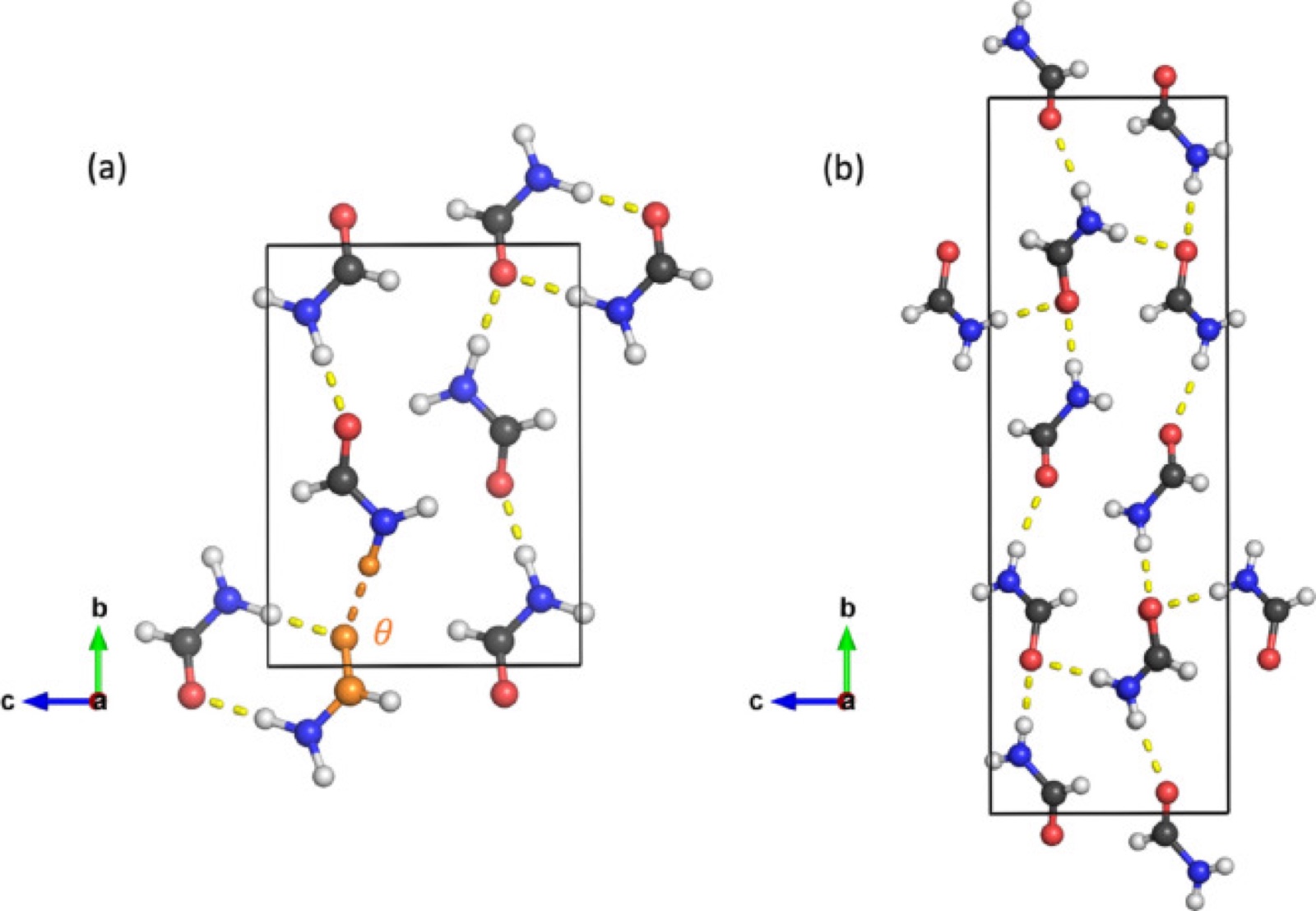
Formamide is a small, simple molecule, but like many molecules it can pack into a solid in more than one way. These different packings are called polymorphs, and they can differ in density, stiffness and stability. One form of formamide appears under ordinary conditions; another appears under pressure. Predicting which packing a molecule adopts, and how that solid behaves, means calculating the energy of the crystal very accurately, because the competing arrangements differ by only tiny amounts of energy.
There are two usual ways to do this, and both have drawbacks. Quantum mechanical calculations treat the electrons properly but are slow, which limits how large a system or how long a simulation can be. Classical force fields are fast simple formulas for the energy, but they usually pin fixed electric charges onto each atom, so they cannot capture how a molecule's electron cloud shifts as it bends and twists inside a crystal. The researchers set out to test a force field designed to avoid that compromise on both formamide polymorphs.
Where AI came in
The machine learning sits inside the force field itself. Instead of fixed charges and fixed bonded terms, FFLUX asks a trained model for the energy belonging to each atom and for that atom's electrical description, both as functions of the molecule's current shape. To build those models, a one-nanosecond molecular dynamics run on a single formamide molecule at 300 K produced many geometries. Quantum chemistry software calculated the electron distribution for selected geometries, and a partitioning scheme divided the result into per-atom energies and multipole moments, the numbers that describe how charge is spread and skewed around each atom.
Those per-atom numbers became training labels for Gaussian process regression, a method that fits a smooth function through known points and reports its own uncertainty. One model was trained per atom per quantity, using twelve numbers describing the molecule's geometry, with further geometries added to the training set by adaptive sampling until the fit was judged adequate. The trained models then stood in for the quantum calculation during the simulations: they supplied the energies, charges and forces used to optimise the crystal structures of both polymorphs, trace energy against volume, and compute vibrational spectra, free energies and infrared spectra. Dispersion and repulsion came from a conventional fitted formula instead.
Written by AIxSci from the checked record below, to give context for readers outside the field. It is not part of the record.
The work
Technical · from the record
The FFLUX force field, which uses per-atom Gaussian process regression models trained on interacting quantum atom partitioning data to predict atomic energies and geometry-dependent multipole moments, was applied to the ambient (α) and high-pressure (β) crystal polymorphs of formamide. Structures were geometry-optimised at multipolar ranks L′ = 0, 1 and 2, and lattice dynamics calculations with Phonopy gave phonon densities of states, Helmholtz free energies and infrared spectra. With multipole moments up to the quadrupole, the α-phase lattice parameters differed from the experimental structure by at most 2.8%, comparable in magnitude to the differences obtained with PBE+D3, while the ambient-pressure β-phase optimisation expanded the a parameter by 7.9% relative to experiment. The fitted bulk modulus of α formamide was 9.87 GPa with FFLUX against 4.99 GPa with PBE+D3, and the authors attribute the remaining discrepancies to the fixed Lennard-Jones parameters used for dispersion and repulsion.
How AI was used
Machine learning supplied the intramolecular energy and the electrostatics of the force field. A 1 ns AMBER molecular dynamics run on a formamide monomer at 300 K generated geometries, which were split into a training set, a 500-point validation set and a 100,000-point sample set; wave functions for training points were computed in GAUSSIAN09 and partitioned with AIMAll to obtain IQA atomic energies and atomic multipole moments. Within the ICHOR pipeline, FEREBUS trained one Gaussian process regression model per atom per target quantity using a modified radial basis function kernel over 12 features defined in atomic local frames, with further sample-set geometries added to the training set by adaptive sampling until the model was judged adequate. The resulting monomeric models predict atomic energies and multipole moments up to the hexadecapole as a function of geometry, evaluated through a modified smooth particle mesh Ewald treatment, while dispersion and repulsion came from a 12-6 Lennard-Jones potential whose parameters were scaled against experimental α-phase density, lattice energy and β angle. The models were then run inside DL_FFLUX/DL_POLY to optimise supercells of both polymorphs at several multipolar ranks and at 1.2 GPa, to compute energy–volume curves, and to supply finite-displacement forces and polarisation derivatives for Phonopy lattice dynamics, free energy and infrared spectrum calculations, with PBE and PBE+D3 calculations in VASP run for comparison.
The shape of the work
Structural · the record, drawn
no AI
Generate monomer geometries for training data
Numerical or physics simulation, including where a learned surrogate replaces it.
A 1 ns AMBER simulation of a formamide monomer at 300 K was performed to generate a set of geometries.where the paper describes this · verbatim
no AI
Compute wave functions and IQA atomic energies and multipole moments
Obtaining raw data, whether by measurement, download or retrieval.
Wave functions for the training points were then calculated in GAUSSIAN09, and an IQA analysis was performed using AIMAllwhere the paper describes this · verbatim
AI
Train per-atom GPR models with adaptive sampling
Fitting model parameters, including fine-tuning an existing model. The AI stood in for simulation. Its result feeds back into an earlier step.
Geometries from the sample set were added to the training set to iteratively improve the model, with the “best” points chosen using adaptive samplingwhere the paper describes this · verbatim
AI
Fit Lennard-Jones nonbonded parameters against α-phase properties
Iterative search over a space.
the nonbonded parameters were optimized for L′ = 2 simulations (multipolar interactions up to quadrupole–quadrupole) by scaling the A and B parameterswhere the paper describes this · verbatim
AI
Optimise α and β crystal structures with FFLUX
Numerical or physics simulation, including where a learned surrogate replaces it. The AI stood in for simulation.
Optimizations were carried out in three stages. Each stage utilized the DL_POLY 0 K optimizerwhere the paper describes this · verbatim
AI
Lattice dynamics, free energies and IR spectra from FFLUX forces
Numerical or physics simulation, including where a learned surrogate replaces it. The AI stood in for simulation.
Lattice dynamics calculations were performed on the structures optimized with PBE+D3 and FFLUX using the Phonopy packagewhere the paper describes this · verbatim
no AI
Compare FFLUX results to experiment and to DFT
Testing outputs against ground truth.
Table 4 compares the FFLUX- and PBE+D3-optimized lattice constants of α and β formamide to the experimental parameterswhere the paper describes this · verbatim
What the record says
Technical · every part carries its own basis
+ in the paper~ our reading− not reported
How to read the quotations. A quotation shows where the paper describes something. It does not quote every value beside it: one passage locates a part of the work, and values without their own quotation are our reading of that passage.
The reported crystal structures, energy–volume curves, phonon spectra, free energies and IR spectra are all produced by FFLUX, whose atomic energies and multipole moments come from the Gaussian process regression models; without them there is no result.
FFLUX utilizes Gaussian process regression machine learning models trained on data from the interacting quantum atom partitioning schemewhere the paper describes this · verbatim
the lattice parameters of the α phase differ by less than 5% to the experimental structure when multipole moments up to the quadrupole are usedwhere the paper describes this · verbatim
The data supporting the findings reported in this paper are openly available from thewhere the paper describes this · verbatim
What this paper did not report
Technical · absence is published deliberately
- CodeWhether the code is available is not stated.
- Trained model weightsWhether the trained model is available is not stated.
- How many were testedThe paper gives no count of what was tested.
- Version of FFLUX per-atom GPR models of IQA atomic energies and atomic multipole moments (trained with FEREBUS/ICHOR)Which version of the model was used is not stated.
- What step 4 replacedThe paper gives no basis for what the AI stood in for.
About this article
Record aix-00187, version 2, checked by a person on 2026-10-09. The record describes the paper; it does not assess whether the paper's findings are right. The paper is published under CC-BY; quotations are at most 25 words. How we work · Report an error