materials-chemistry/ai produced the result/arXiv 2024 · v2
Pretrained potentials give a structure search a head start in finding atomic arrangements
Researchers swapped the starting guess inside a structure-search method for a pretrained machine learning model of atomic forces, then tested how often the search found the lowest-energy arrangement of silica, a copper cluster and a titanium dioxide surface.
spectrum · one line per step, placed by what the step does · bright lines used AI
Bayesian optimization of atomic structures with prior probabilities from universal interatomic potentials
arXiv, 2024
doi:10.48550/arxiv.2408.15590 · record aix-00126 v2 · checked 2026-10-08
- AI was for
- Simulation surrogate, Experimental design, Structure determination
- Model family
- Gaussian process, Graph neural network
- Checked by
- Benchmark10 tested
- Code
- available
The finding the paper is about came from the AI.
What this research was about
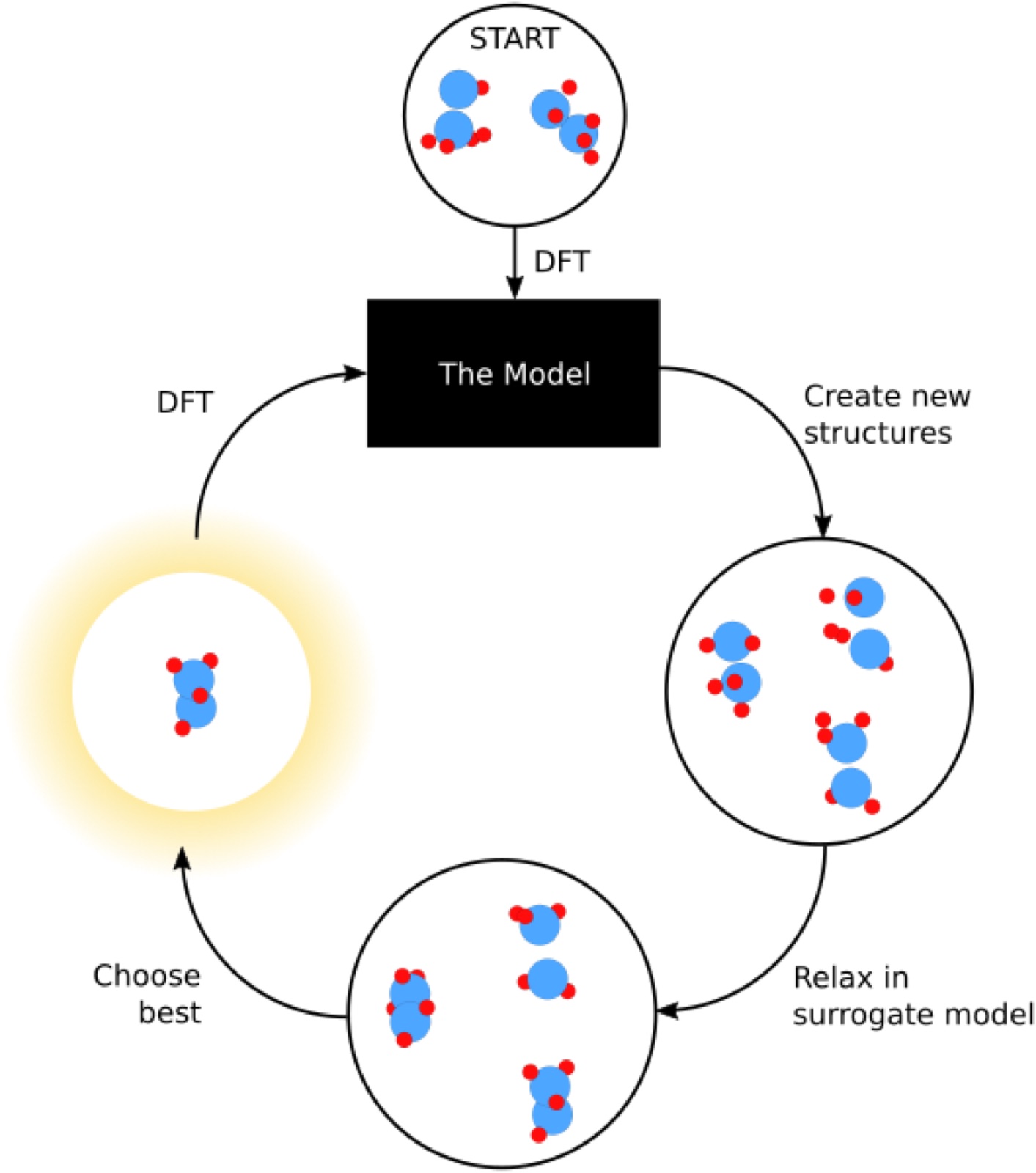
Many properties of a material follow from how its atoms are arranged. Finding that arrangement from scratch means hunting for the configuration with the lowest energy, out of an enormous number of ways atoms can sit relative to one another. Energies can be computed from quantum mechanics using density functional theory, or DFT, but each calculation costs real computer time, so a search cannot afford to test many candidates. One way around this is a surrogate: a cheap statistical stand-in, fitted to the handful of DFT results already in hand, that guesses the energy of untested arrangements and says how confident it is.
The surrogate here is a Gaussian process, a method that interpolates between known data points and supplies an uncertainty alongside each prediction. Such a model needs a prior, a default assumption about the energy landscape before any data arrives. In the search framework the researchers used, that default had been deliberately uninformative. They replaced it with a pretrained universal machine learning potential, so the Gaussian process only had to learn the gap between that potential's estimate and DFT.
Where AI came in
Two off-the-shelf potentials, MACE-MP-0 and M3GNet, were used as the prior without any further training on the systems at hand. Both are neural networks trained to predict energies and forces for atoms of many elements. Around them sat the Gaussian process, retrained at every cycle on the growing store of DFT energies and forces. The search then ran forty energy minimisations on this learned surface, ranked the resulting candidates by predicted energy and uncertainty, and sent only one of them to DFT before repeating, a hundred cycles per run.
So the learned models were the search engine rather than a later analysis step. They stood in for the expensive quantum calculation during the exploring, which is what made it affordable to explore at all. The MACE-MP-0 prior raised the success rate on all three test systems, and reached the titanium dioxide answer in roughly twenty single-point calculations against roughly forty for the original prior, while M3GNet matched the original on silica and did worse on the other two. Relaxing a thousand random structures with MACE-MP-0 alone found the silica answer in 0.9% of cases.
Written by AIxSci from the checked record below, to give context for readers outside the field. It is not part of the record.
The work
Technical · from the record
The study replaces the uninformative prior mean of the Gaussian process surrogate in the BEACON global structure optimisation framework with a pretrained universal machine learning potential, so the Gaussian process fits only the difference between that potential and DFT. Two potentials, MACE-MP-0 and M3GNet, were compared with the standard BEACON prior on bulk SiO2 with 12 atoms, a 20-atom copper cluster, and the anatase TiO2(001)-(1 x 4) surface reconstruction with 27 atoms. The MACE-MP-0 prior raised the success rate of finding the global minimum on all three systems, reaching the TiO2 global minimum in approximately 20 single-point calculations compared with approximately 40 for standard BEACON, while M3GNet matched the standard prior for SiO2 and performed worse for the cluster and the surface. A random structure search using MACE-MP-0 relaxations alone over 1000 structures found the SiO2 global minimum in 0.9% of cases and the TiO2 global minimum in 9 of 1000 structures.
How AI was used
Each optimisation run began with a small database of randomly generated configurations evaluated with GPAW DFT using the PBE functional. A Gaussian process with gradients, using a squared exponential kernel over a modified Valle-Oganov fingerprint and hyperparameters updated each iteration, was fitted to the database energies and forces. The prior mean of that Gaussian process was either the standard BEACON prior (mean DFT energy plus a short-ranged repulsive pair potential) or a pretrained universal machine learning potential, MACE-MP-0 (medium) or M3GNet (M3GNet-MP-2021.2.8-PES) loaded through matgl, both used without further fine-tuning and offset by the iteratively updated mean energy difference between DFT and the potential; the repulsive term was retained and the potential's energy omitted when interatomic distances fell below half the smallest covalent radius. Forty energy minimisations of up to 500 steps were run on the surrogate surface from random configurations, the resulting minima were ranked by a lower confidence bound acquisition function, and the selected configuration was evaluated with DFT and added to the database, closing the active learning loop over 100 cycles per run. As a comparison, 1000 random structures per system were relaxed with MACE-MP-0 alone and then evaluated with DFT, and both potentials were also run over the DFT-evaluated structures from a single run to compare their predicted energies with DFT.
The shape of the work
Structural · the record, drawn
no AI
Generate random starting structures
Producing candidate objects that did not previously exist.
random structures are generated by placing atoms randomly within a box or a randomly generated unit cell (if periodic conditions apply)where the paper describes this · verbatim
no AI
Compute DFT energies and forces
Numerical or physics simulation, including where a learned surrogate replaces it.
All DFT calculations are performed using the Atomic Simulation Environment library and the GPAW code with the PBE xc-functional.where the paper describes this · verbatim
AI
Fit Gaussian process surrogate on top of MLP prior
Fitting model parameters, including fine-tuning an existing model. The AI stood in for simulation.
A Gaussian process surrogate potential energy surface is constructed from the database.where the paper describes this · verbatim
AI
Relax random structures on the surrogate surface
Iterative search over a space. The AI stood in for simulation.
The surrogate potential energy surface (PES) is explored through 40 energy minimizations, equaling the number of CPU cores availablewhere the paper describes this · verbatim
no AI
Select next structure by acquisition function
Reducing a candidate set by filtering or ranking, in a single pass.
The configurations are assessed using the lower confidence bound acquisition functionwhere the paper describes this · verbatim
no AI
Evaluate selected structure with DFT and extend database
Numerical or physics simulation, including where a learned surrogate replaces it. Its result feeds back into an earlier step.
a DFT calculation for the configuration with the lowest acquisition function value is added to the databasewhere the paper describes this · verbatim
AI
Baseline random structure search with the MLP alone
Iterative search over a space. The AI stood in for simulation.
we performed a random structure search (RSS) where 1000 random structures were generated and optimized using the MACE-MP-0 potentialwhere the paper describes this · verbatim
no AI
Check whether the known global minimum was found
Testing outputs against ground truth.
The StructureMatcher class from pymatgen is used to verify if the global minimum has been found.where the paper describes this · verbatim
What the record says
Technical · every part carries its own basis
+ in the paper~ our reading− not reported
How to read the quotations. A quotation shows where the paper describes something. It does not quote every value beside it: one passage locates a part of the work, and values without their own quotation are our reading of that passage.
The reported result is the rate at which a Gaussian-process surrogate with a machine-learning-potential prior locates the global minimum structure; the learned surrogate is the search engine, not a post-hoc analysis step.
By using the machine learning potentials as priors for the Gaussian processwhere the paper describes this · verbatim
the cumulative success rate of locating the global minimum across 10 individual runswhere the paper describes this · verbatim
The code used is available at https://gitlab.com/gpatom/ase-gpatom/-/tree/ML_prior.where the paper describes this · verbatim
What this paper did not report
Technical · absence is published deliberately
- Trained model weightsWhether the trained model is available is not stated.
- DataWhether the data are available is not stated.
- Version of BEACON Gaussian process surrogate potential (with gradients)Which version of the model was used is not stated.
About this article
Record aix-00126, version 2, checked by a person on 2026-10-08. The record describes the paper; it does not assess whether the paper's findings are right. The paper is published under CC-BY; quotations are at most 25 words. How we work · Report an error