materials-chemistry/ai produced the result/Nature Communications 2022 · v2
A single neural network stands in for quantum calculations across 45 elements
Researchers trained one neural network potential, called PFP, on their own database of quantum chemistry calculations, then used it instead of those calculations to study lithium movement, porous frameworks, alloy ordering and cobalt catalysts.
spectrum · one line per step, placed by what the step does · bright lines used AI
Towards universal neural network potential for material discovery applicable to arbitrary combination of 45 elements
Nature Communications, 2022
doi:10.1038/s41467-022-30687-9 · record aix-00062 v2 · checked 2026-10-08
- AI was for
- Simulation surrogate
- Model family
- Graph neural network
- Checked by
- Replication20 tested
- Code
- available
The finding the paper is about came from the AI.
What this research was about
To predict how a material behaves, chemists need to know its energy: how much energy a particular arrangement of atoms holds, and what forces push each atom around. The standard way to work this out is density functional theory, or DFT, an approximate solution of the quantum mechanics of electrons. DFT is accurate enough for much of materials science, but it is slow. A single reaction pathway can take hours or days of computer time, and that cost limits how many candidate materials anyone can examine.
One way round the cost is a potential: a cheaper formula that takes atomic positions and returns energies and forces directly, skipping the electrons. Traditional potentials are hand-built for a narrow set of elements and break down outside it. The researchers set out to build one potential that works for any combination of 45 elements, including arrangements that are strained, disordered or not at equilibrium, so it could be pointed at different problems without being rebuilt each time.
Where AI came in
The potential itself is the AI. PFP is a graph neural network, built on an architecture called TeaNet, which treats a structure as atoms joined by neighbour links and passes information along them to work out each atom's contribution. It was trained by supervised learning on energies, forces and charges from DFT calculations the authors generated themselves, deliberately including distorted, unstable and disordered structures, plus the public OC20 dataset. Because the data sources used inconsistent DFT settings, the model was given a label for the calculation conditions, selectable afterwards as a mode.
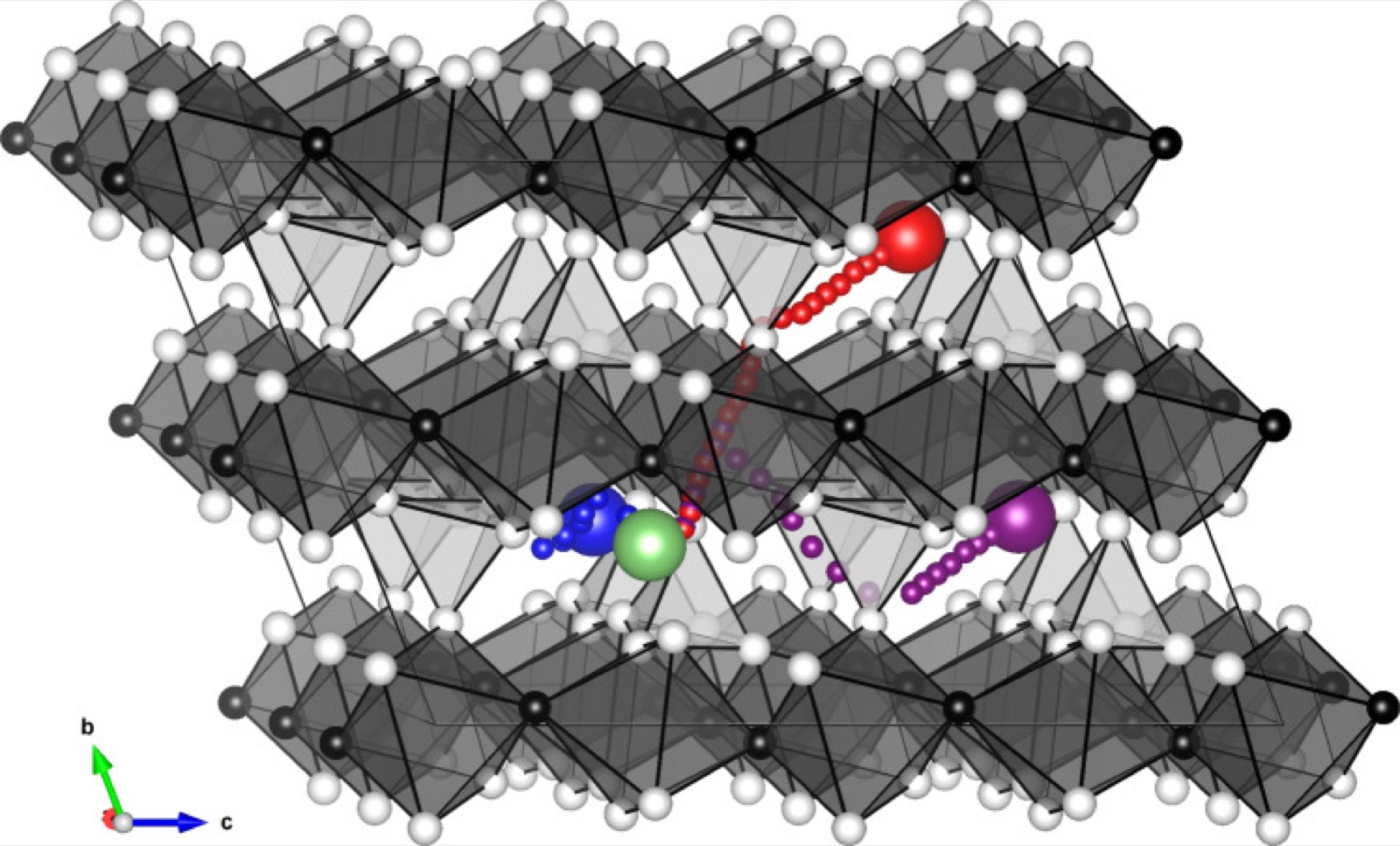
Once trained, the network replaced DFT inside ordinary simulation machinery. It supplied the energies and forces for reaction-path and molecular dynamics calculations of lithium diffusion in LiFeSO4F, for optimising metal-organic framework cells and water binding energies, for Monte Carlo sampling of copper-gold ordering, and for methanation barriers on cobalt and a screen of eleven candidate promoter elements. Results were checked against published DFT numbers and experimental values; across 20 methanation reactions the mean absolute error was 0.097 eV, and vanadium gave the largest barrier reduction, around 40%. One lithium calculation took about five minutes on a single GPU.
Written by AIxSci from the checked record below, to give context for readers outside the field. It is not part of the record.
The work
Technical · from the record
The authors trained a single neural network potential, PFP, on an original DFT dataset built to include unstable, distorted and disordered structures, so that it covers any combination of 45 elements. They then used it in place of DFT for four kinds of calculation: lithium diffusion barriers in LiFeSO4F, cell optimisation and water binding energies in metal-organic frameworks, Monte Carlo sampling of the Cu–Au order–disorder transition, and activation energies for methanation and CO dissociation on cobalt surfaces. Computed values were compared with published DFT and experimental reference values; for 20 methanation elementary reactions the correlation coefficient was 0.98 and the mean absolute error 0.097 eV, and a screen of eleven candidate promoter elements for CO dissociation on a stepped Co surface gave the largest barrier reduction, about 40%, for vanadium.
How AI was used
A graph neural network potential, PFP, built on the TeaNet architecture with second-order Euclidean tensor message passing over five layers (cutoffs 3, 3, 4, 6 and 6 Å) and an added trained Morse-style two-body term, was fitted to energies, atomic forces and atomic charges from the authors' own molecular dataset (ωB97X-D/6-31G(d) in Gaussian 16, nine elements) and crystal dataset (spin-polarised PBE+U in VASP 5.4.4, 45 elements), together with the public OC20 dataset; because these sources use mutually inconsistent DFT settings, a DFT-condition label was supplied as an additional input during training and selected at inference as a calculation mode. Training structures were deliberately diversified with element substitutions, varied cell volumes and shapes, randomly displaced atoms, high-temperature MD snapshots, disordered configurations and two-body potential curves. The trained model was then run as a surrogate energy and force engine inside conventional simulation drivers: climbing-image NEB and molecular dynamics for lithium diffusion, cell and geometry optimisation with an optional GPU-accelerated Grimme D3 dispersion correction for metal-organic frameworks, Metropolis Monte Carlo for Cu–Au alloy configurations, and CI-NEB for methanation reactions and for a substitution screen of candidate promoter elements on a stepped cobalt surface. Outputs were compared against published DFT values, experimental structures and reported transition temperatures, with an OC20 DimeNet++ model run for comparison in the supplementary material.
The shape of the work
Structural · the record, drawn
no AI
Generate DFT training dataset
Obtaining raw data, whether by measurement, download or retrieval.
In this study, we generated an original dataset which covers various systems.where the paper describes this · verbatim
AI
Train the PFP potential
Fitting model parameters, including fine-tuning an existing model. The AI stood in for simulation. Its result feeds back into an earlier step.
we assigned labels corresponding to the DFT conditions during training and trained the entire dataset concurrentlywhere the paper describes this · verbatim
AI
Compute lithium diffusion barriers in LiFeSO4F
Numerical or physics simulation, including where a learned surrogate replaces it. The AI stood in for simulation.
We calculated the activation energy of lithium diffusion in LiFeSO4F using the CI-NEB method using PFPwhere the paper describes this · verbatim
AI
Optimise MOF cells and compute water binding energies
Numerical or physics simulation, including where a learned surrogate replaces it. The AI stood in for simulation.
To test the applicability of PFP to MOFs, some representative materials were selected, and the cell geometries were optimized.where the paper describes this · verbatim
AI
Monte Carlo simulation of Cu–Au ordering
Numerical or physics simulation, including where a learned surrogate replaces it. The AI stood in for simulation.
we conducted Metropolis Monte Carlo (MC) simulations to investigate the transition temperature between ordered and disordered phaseswhere the paper describes this · verbatim
AI
Compute methanation reaction barriers on Co(0001)
Numerical or physics simulation, including where a learned surrogate replaces it. The AI stood in for simulation.
The activation energy was determined by CI-NEB using 14 images for each process.where the paper describes this · verbatim
AI
Screen promoter elements for CO dissociation
Reducing a candidate set by filtering or ranking, in a single pass. The AI stood in for simulation.
In the promoter search process, a Co atom was randomly replaced with a promoter element, and the CI-NEB calculations were repeated over the surface.where the paper describes this · verbatim
no AI
Compare outputs with published DFT and experimental values
Testing outputs against ground truth.
Figure 4 shows a comparison of the computed activation energies between PFP and the reported values.where the paper describes this · verbatim
What the record says
Technical · every part carries its own basis
+ in the paper~ our reading− not reported
How to read the quotations. A quotation shows where the paper describes something. It does not quote every value beside it: one passage locates a part of the work, and values without their own quotation are our reading of that passage.
Every reported result — diffusion barriers, MOF geometries and binding energies, transition temperatures, methanation barriers, promoter identification — is produced by running the trained neural network potential in place of DFT
The TeaNet architecture was used for the base NNP architecture of the PFP.where the paper describes this · verbatim
20 elementary reactions on the Co(0001) surface have been examined, and corresponding activation energies are compared with the values reported in the literature.where the paper describes this · verbatim
The simulation script files and output data are provided in Supplementary Data 1.where the paper describes this · verbatim
What this paper did not report
Technical · absence is published deliberately
- Trained model weightsWhether the trained model is available is not stated.
- Version of PreFerred Potential (PFP), based on TeaNetWhich version of the model was used is not stated.
- Version of DimeNet++ (OC20 model)Which version of the model was used is not stated.
About this article
Record aix-00062, version 2, checked by a person on 2026-10-08. The record describes the paper; it does not assess whether the paper's findings are right. The paper is published under CC-BY; quotations are at most 25 words. How we work · Report an error