materials-chemistry/ai produced the result/Nature Communications 2020 · v2
Neural network trained on quantum calculations maps how gallium melts and freezes
Researchers fitted a neural network to quantum-mechanical calculations of gallium, then used it to run long atomic simulations. From these they computed the metal's phase diagram, its liquid structure, and how its crystals first form.
spectrum · one line per step, placed by what the step does · bright lines used AI
Ab initio phase diagram and nucleation of gallium
Nature Communications, 2020
doi:10.1038/s41467-020-16372-9 · record aix-00028 v2 · checked 2026-10-07
- AI was for
- Simulation surrogate
- Model family
- Multilayer perceptron
- Checked by
- Held-out
- Code
- not reported
The finding the paper is about came from the AI.
What this research was about
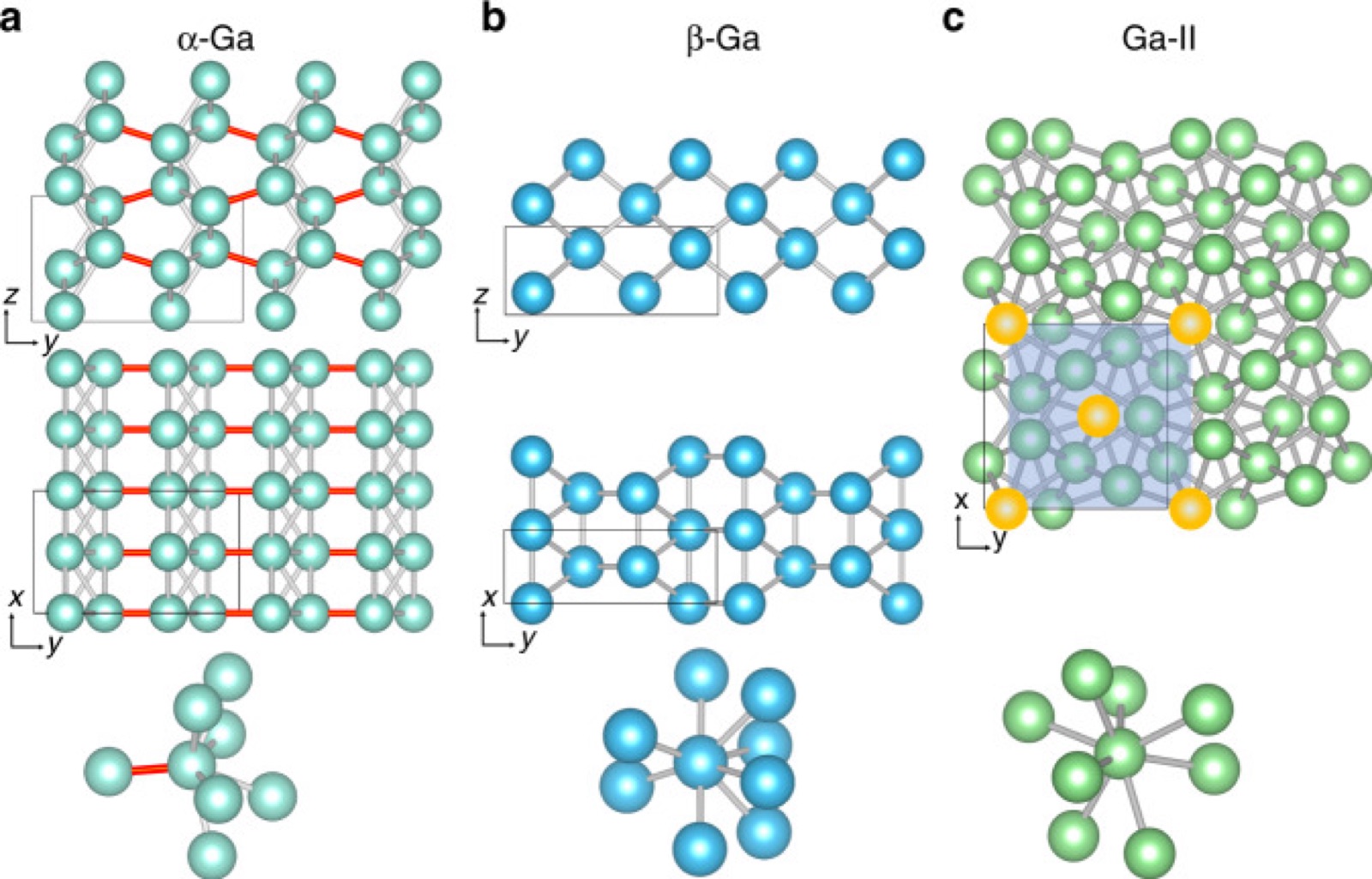
Gallium is a metal that melts near room temperature, and it can freeze into more than one crystal form. Which form appears, and at what temperature and pressure, is set by the forces between atoms. Those forces can be worked out from quantum mechanics, using a method called density functional theory, but the calculation is costly. Following atoms as they rearrange over the long stretches of time that melting and freezing need would mean repeating that calculation many millions of times. Cheaper hand-built approximations to the forces exist, but they are not tied closely to the quantum answer.
The authors set out to bridge that gap for gallium: to obtain forces of quantum quality at a cost low enough for long simulations, and then to use them to compute where the liquid and the solid forms sit on a map of temperature and pressure, what the liquid looks like at the atomic scale, and how the first tiny crystals, or nuclei, form inside the liquid.
Where AI came in
The AI is a neural network that predicts the energy of a group of gallium atoms and the forces on each one. It was trained on 28,000 atomic arrangements whose energies and forces had been computed with density functional theory. The arrangements came from simulations of gallium freezing, covering liquid, solid and in-between configurations; the process was iterated, with the part-trained network used to generate fresh arrangements that were then relabelled with the quantum method and fed back into training. On held-out arrangements the network's energies differed from the quantum values by 2.8 meV per atom.
The trained network then stood in for the quantum calculation in every simulation reported. It supplied the forces for the runs that produced the phase diagram between 240 and 340 K and 0 and 2.6 GPa, for the simulations of crystals forming in systems of 144, 2,400 and 2,560 atoms, and for the runs started from pre-formed nuclei that gave the critical nucleus sizes. The nucleation barriers and rates were then worked out from those outputs using classical nucleation theory, without AI.
Written by AIxSci from the checked record below, to give context for readers outside the field. It is not part of the record.
The work
Technical · from the record
The authors trained a deep neural-network interatomic potential for gallium on density functional theory energies and forces computed for configurations drawn from enhanced-sampling simulations that spanned liquid, solid and coexisting arrangements. Running that potential, they computed the liquid–α-Ga–β-Ga–Ga-II phase diagram between 240 and 340 K and 0 and 2.6 GPa, the structure of liquid gallium, and the nucleation of α-Ga and β-Ga. The calculated liquid-α-II triple point is 280.9 K and 1.58 GPa against an experimental value of 276.2 K and 1.19 GPa, and the computed melting temperature of α-Ga is 309.5 ± 6 K against an experimental 302.9 K. From seeded molecular dynamics and classical nucleation theory they report that the nucleation barriers of the two crystal phases cross at 174 ± 3 K, with β-Ga having the lower barrier above that temperature.
How AI was used
A deep neural-network potential (DeePMD) was fitted to reproduce ab initio energies and forces for gallium so that long molecular dynamics runs could be performed at a cost far below first-principles dynamics. Training configurations were collected by first running metadynamics of α-Ga nucleation with a classical empirical potential, then recomputing energies and forces for the extracted configurations with DFT (LDA functional, CP2K Quickstep, 600 Ry cutoff, 144 or 160 atoms per cell), and training a network of five hidden layers with 240, 120, 60, 30 and 10 neurons using the ADAM optimizer with a learning rate decaying from 1e-3 to 1e-5 on a total of 28,000 configurations. The procedure was iterated: an intermediate potential was used to run isothermal–isobaric nucleation simulations of α-Ga, β-Ga and Ga-II, and then multithermal–multibaric simulations, whose configurations were relabelled with DFT and used to retrain, yielding a potential intended for 150–340 K and 1 bar to 2.6 GPa. The resulting potential then supplied the forces for all subsequent simulations: variationally enhanced sampling multithermal–multibaric runs driven by SOAP-based per-atom crystallinity collective variables to obtain liquid–solid free energy differences and coexistence lines, well-tempered metadynamics nucleation runs in 144-, 2400- and 2560-atom systems, and seeding runs started from five extracted nuclei per phase to locate critical nucleus sizes. Barriers, interfacial free energies and rates were then obtained from classical nucleation theory expressions applied to those simulation outputs.
The shape of the work
Structural · the record, drawn
no AI
Generate candidate configurations by enhanced sampling
Numerical or physics simulation, including where a learned surrogate replaces it.
we start with a metadynamics calculation of α-Ga nucleation at ambient pressure using a classical potentialwhere the paper describes this · verbatim
no AI
Label configurations with DFT energies and forces
Numerical or physics simulation, including where a learned surrogate replaces it.
The single-point energy and forces calculations for the training set used a energy cutoff of 600 Ry.where the paper describes this · verbatim
AI
Train deep neural-network potential
Fitting model parameters, including fine-tuning an existing model. The AI stood in for simulation. Its result feeds back into an earlier step.
The DeePMD-kit package is used for the training of the NN potential and to interface the NN potential to LAMMPS.where the paper describes this · verbatim
AI
Compute phase diagram with multithermal–multibaric simulations
Numerical or physics simulation, including where a learned surrogate replaces it. The AI stood in for simulation.
we have performed three multithermal–multibaric simulationswhere the paper describes this · verbatim
AI
Simulate homogeneous nucleation of α-Ga and β-Ga
Numerical or physics simulation, including where a learned surrogate replaces it. The AI stood in for simulation.
we have performed several metadynamics simulations using the NN potentialwhere the paper describes this · verbatim
AI
Seeding runs to find critical nucleus sizes
Numerical or physics simulation, including where a learned surrogate replaces it. The AI stood in for simulation.
In the seeding MD simulations, five initial configurations were extracted from the nucleation trajectorieswhere the paper describes this · verbatim
no AI
Derive nucleation barriers and rates from CNT
Extracting understanding from model behaviour.
The nucleation rates J of α-Ga and β-Ga at 170 K and 180 K are estimated following Eq. (18)where the paper describes this · verbatim
no AI
Compare predictions with experimental data
Testing outputs against ground truth.
Both the melting temperatures and the lattice parameters are in good agreement with experiments.where the paper describes this · verbatim
What the record says
Technical · every part carries its own basis
+ in the paper~ our reading− not reported
How to read the quotations. A quotation shows where the paper describes something. It does not quote every value beside it: one passage locates a part of the work, and values without their own quotation are our reading of that passage.
The neural-network potential supplies the energies and forces for every simulation reported; the phase diagram, liquid structure and nucleation results are all produced by running it
we construct an ab initio quality interaction potential by training a neural network on a set of density functional theory calculationswhere the paper describes this · verbatim
The root mean square errors of the NN potential on the testing set are equal to 2.8 meV per atomwhere the paper describes this · verbatim
What this paper did not report
Technical · absence is published deliberately
- CodeWhether the code is available is not stated.
- Trained model weightsWhether the trained model is available is not stated.
- DataWhether the data are available is not stated.
- ComputeThe hardware or time used is not stated.
- How many were testedThe paper gives no count of what was tested.
- Version of DeePMD deep potential for galliumWhich version of the model was used is not stated.
About this article
Record aix-00028, version 2, checked by a person on 2026-10-07. The record describes the paper; it does not assess whether the paper's findings are right. The paper is published under CC-BY-4.0; quotations are at most 25 words. How we work · Report an error